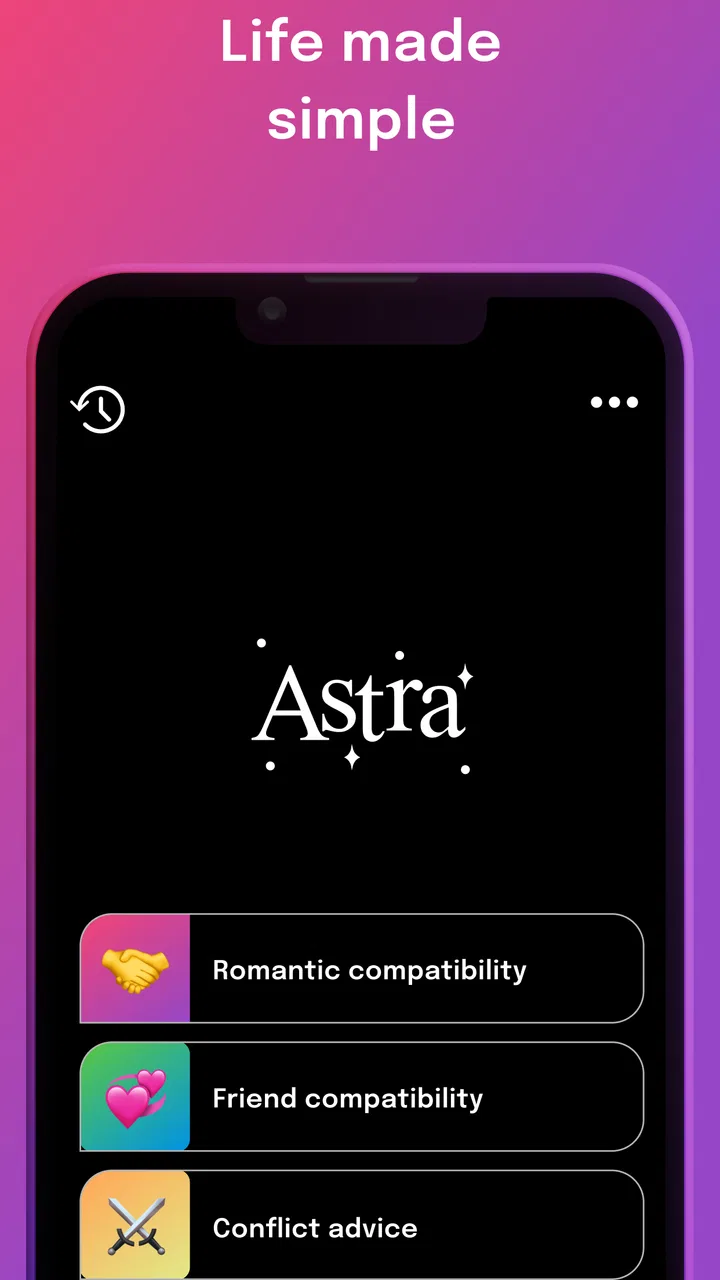
Astra - Life Advice
- 4.4
- Rating
- 500.00K
- Installs
- Free
- Price

 Analysis by App-foxy
I tried Astra - Life Advice as a lightweight astrology and lifestyle app, and my first impression was that it aims to make reflective guidance feel easy to approach rather than mysterious or overloaded. Its store summary, “Astrology made simple,” is a fair description of the overall direction. I would not treat it as a replacement for professional advice or serious decision-making, but I can see why someone might open it during a quiet morning, a stressful evening, or a moment when they simply want a prompt to think about their day.
What makes the app worth considering is its narrow focus. Instead of presenting itself as a huge social platform or an all-purpose productivity tool, it sits in the lifestyle category and keeps the experience centered on astrology-inspired advice. That makes it easier to fit into a personal routine. At the same time, that simplicity means the app will not satisfy everyone. If you want detailed evidence, practical planning tools, or a fully customizable household organizer, you will probably need something else alongside it.
How Astra feels in an everyday household routine
The most useful way I found to think about Astra is as a personal reflection tool that can be used around other people without necessarily becoming a shared account experience. Imagine a household where one person checks it before work, another looks at it after dinner, and a teenager opens it privately when they want a little perspective. The app can become part of the rhythm of the home, but the value depends on keeping each person’s interpretation and use separate.
You May Also Like

 Blood Strike: 2.5 Anniversary
Blood Strike’s Loadouts Turn Every Drop Into a Tactical Gamble
A close look at Blood Strike’s custom loadouts: how fast access to signature weapons reshapes its battle royale rhythm, rewards preparation, and narrows the gap between fights.

 Pandora - Music & Podcasts
Pandora’s Music Is Easy to Start, but Harder to Recover
Pandora’s strength is its low-effort path from a seed to a station. Its weak spot is how much confidence it asks you to place in connection, setup, and quiet recovery.

 8 Ball Pool
 Is Built on Rivalries, Rematches, and Routine
A close look at the rivalries, rematches, shared routines, and unanswered safety questions that turn a quick pool match into a persistent mobile community.

 Samsung Music
’s Quiet Strength Is Playing What You Already Own
Its reach comes less from spectacle than from dependable access to a personal library. That simplicity is both the app’s strongest retention engine and its ceiling.

 AccuWeather: Weather Radar
AccuWeather Review: A Quick, Clear Forecast for Everyday Decisions
For everyday plans, the best forecast is the one you can understand quickly. AccuWeather makes rain timing, radar, and local conditions easy to act on, with a few trade-offs.

 Hill Climb Racing
Why Hill Climb Racing Still Turns Crashes Into One More Run
A tiny car, a bumpy hill and one more upgrade: Hill Climb Racing keeps resurfacing because its simple chaos makes every near-miss feel personal.
More From Our News Desk



For example, I could see one partner using the app to start a calmer conversation about the day, while another person treats the same kind of guidance as entertainment. That difference matters. Astrology can be meaningful to one user and purely playful to another, so I would avoid turning an app reading into a household rule. A suggestion about patience or communication can be a useful conversation starter, but it should not be used to label someone’s personality or decide who is right during an argument.
On a shared phone or tablet, I would also be deliberate about who is using the app at any given moment. The safest routine is simple: each person checks their own information, avoids leaving personal screens open, and does not assume that a reading intended for one user applies to everyone. That is not a criticism of Astra specifically; it is a sensible boundary for any app that may involve personal preferences, birth information, or reflective questions.
The strongest household use is coordinated reflection, not shared diagnosis. A family might agree to use the app as a prompt for a weekly check-in, such as discussing what felt difficult or what each person wants to improve. The conversation should remain about real experiences rather than treating the app as an authority. Used that way, Astra adds a little structure without taking control of the discussion.
Keeping setup personal on a shared device
Before introducing Astra to a shared device, I would decide who the primary user is and what information should remain private. The app is free to install, which makes trying it low-risk from a cost perspective, but free access does not automatically mean that every household member should use one setup. If several people want to explore it, I would give each person a turn and avoid mixing their details into one profile or one conversation.
This is especially important when a parent and teenager use the same phone. The content rating is Teen, so I would place it in the category of an age-appropriate lifestyle experience for older children and adults, not a children’s educational app. A teenager may enjoy the reflective side of astrology, but an adult should still explain that the readings are not medical, legal, academic, or financial instructions. That small conversation prevents the app from being given more authority than it deserves.
I also recommend checking the purchase flow before handing the device to someone else. The app includes in-app purchases priced at $6.99 per item. That does not make the free version unattractive, but it does mean a shared device deserves a little attention from the account owner. I would not let a younger household member explore purchase screens without supervision, and I would make sure everyone understands that optional paid content is different from the basic free download.
There is a practical trade-off here. A shared device is convenient, but convenience can blur boundaries. A personal phone makes it easier for each user to keep their experience distinct, while a family tablet makes casual discovery easier but requires more care. Astra works in either context as long as the household treats it as an individual lifestyle app rather than a communal profile.
Using readings to coordinate without overstepping
I found the app more useful when I treated its guidance as a starting point for action. If a reading encourages reflection about communication, I might use that as a reminder to send a message I have been postponing or to pause before answering sharply. If it points toward rest, I can compare that idea with my actual schedule. The important step is translating a broad prompt into a small, real-world choice.
That approach can work well between people who share responsibilities. A couple could use a reading as a gentle prompt to ask, “What do we need to handle today?” A household could turn a general theme into a practical plan: one person takes care of an errand, another protects a quiet hour, and everyone knows what is expected. The app does not need to coordinate those tasks itself to be useful; it can simply help begin the conversation.
Still, I would draw a firm line between coordination and control. If one person says, “Astra says you should do this,” the experience quickly becomes irritating. The app should not be used to pressure a partner, excuse poor behavior, or make decisions for someone who does not believe in astrology. Its best role is optional and conversational. The moment it becomes a test that another person must pass, its value drops.
A useful personal workflow is to read the guidance once, write down one practical takeaway, and revisit that takeaway later without reopening the app immediately. This prevents endless checking for a more favorable answer. It also makes the experience less passive. Instead of waiting for the app to tell me what the day means, I use it to decide what I want to notice about the day.
Another worthwhile habit is comparing the app’s prompt with observable circumstances. If the advice suggests taking things slowly but I have an urgent deadline, the correct response is not to ignore reality. I can interpret the suggestion as a reminder to work carefully, not as a reason to miss the deadline. That is where Astra feels most responsible in practice: when the user keeps common sense in charge.
Age, trust, and the right level of skepticism
The Teen rating gives parents and guardians a useful starting point, but a rating alone cannot explain how a particular teenager will respond to astrology. Some teens will see Astra as harmless entertainment. Others may take personalized-sounding advice very seriously, especially when they are anxious or uncertain. I would introduce it with a simple rule: enjoy the reflection, but verify important decisions through trustworthy people and reliable sources.
That matters for adults too. A polished lifestyle app can make general statements feel personally precise, even when the user is filling in much of the meaning. I like the reflective mood, but I would not use it to choose treatment, manage a crisis, judge a relationship, or make a major money decision. If a reading increases worry rather than helping someone think clearly, closing the app is the better choice.
Trust also affects shared use. A teenager may not want a parent reading every personal interpretation, and a partner may not want their private reflections turned into a group discussion. I would ask before sharing anything. Astra can support a healthy conversation only when participation is voluntary. Respecting that boundary is more important than getting everyone in the household to use the same app.
For younger users, I would be particularly careful with language about fate, compatibility, or personal identity. Even if the app is presented as lifestyle content, a child can interpret broad guidance as a fixed description of who they are. Since the rating is Teen rather than a children’s classification, I would keep its use with older users who can understand the difference between a suggestion and a fact.
What the app does well and where friction appears
Astra’s biggest strength is approachability. The “simple astrology” idea is not just a short slogan in my experience; it describes why someone might return to the app instead of abandoning it after a complicated first session. People who are curious but not deeply familiar with astrology may appreciate having a less intimidating entry point.
Its lifestyle positioning is another advantage. I can imagine opening it for a brief pause rather than committing to a long reading session. That suits users who want a small daily ritual, a prompt for journaling, or a way to shift attention before starting work. The app is also easier to recommend to a friend who wants something reflective but does not want a large community, a competitive system, or a demanding schedule.
The limitation is the same as the attraction: simplicity can feel shallow to experienced astrology users. Someone looking for extensive chart analysis, deep customization, or a detailed learning environment may find the experience too light. I would choose a specialist astrology service for serious study and Astra for casual personal reflection. Those are different jobs, and expecting one app to do both leads to disappointment.
The optional purchases also change how I would evaluate the experience over time. The free starting point is helpful for deciding whether the tone suits you, but I would not buy anything impulsively just because a reading feels emotionally relevant. I would use the free experience long enough to understand whether the app genuinely fits my routine. If it becomes a source of repeated reassurance-seeking, spending more will not solve the underlying problem.
Another point of friction is interpretation. The app may offer a convenient prompt, but the user still has to decide what it means in context. That is not necessarily a flaw, yet it means Astra is less useful for someone who wants direct, measurable instructions. A calendar, habit tracker, journal, or counseling conversation will be better when the goal is accountability rather than inspiration.
How it compares with familiar alternatives
Compared with a traditional horoscope website, Astra feels more suited to a phone-based routine. A website can be better when I want to browse several sources or read longer explanations, while a dedicated app is more convenient when I want one consistent place to check. The trade-off is that a website may offer broader comparison, whereas Astra’s focused experience is likely to feel less cluttered.
Compared with a journaling app, Astra supplies the initial prompt instead of asking me to create one from scratch. That is helpful on days when I feel mentally tired and do not know what to write. A journal remains stronger for tracking patterns in my own words, though. The best combination would be to use Astra for a starting question and a journal for the answer, rather than expecting the app to preserve every useful insight.
Compared with a meditation app, Astra is more interpretive and less practice-oriented. Meditation tools usually guide breathing, attention, or relaxation directly. Astra is better for meaning-making and reflection. If I am tense and need an immediate calming exercise, I would choose meditation. If I want a prompt that helps me examine my mood or intentions, Astra is the more natural fit.
Compared with a family calendar or task manager, Astra is not a replacement for coordination. It cannot take the place of a shared schedule, a shopping list, or a clear division of chores. Its contribution is softer: it may help people talk about the day, but the actual logistics still belong in a practical tool. This distinction is especially important in a busy household where vague encouragement is not enough.
Who should try it, and who should skip it
I would recommend Astra to adults and older teens who enjoy astrology as a reflective or entertaining part of a lifestyle routine. It is a good match for someone who wants a simple app to open briefly, prefers approachable guidance, and understands that personal judgment matters more than any prediction. It can also suit a household where different people want to explore astrology separately while occasionally sharing general themes.
I would skip it if I wanted scientifically grounded explanations, structured mental-health support, or a tool that manages family responsibilities. I would also skip it if astrology tends to increase my anxiety or make me seek repeated confirmation before acting. In those situations, a journal, a trusted conversation, a professional service, or a straightforward planning app would be more helpful.
The app’s scale suggests that it has already attracted a substantial audience: it holds a 4.4 average from around seventeen thousand ratings and has passed 500,000 installs. Those figures make it easier to see Astra as an established option rather than an obscure experiment, but popularity should not decide whether its style suits you. The developer is Vert Media Partners, and the current version is 2.5.2, so I would still judge it by the actual experience on my device rather than by adoption alone.
It is also worth noting that the app was released on October 3, 2024, and supports Android 7.0 or later. That makes it accessible to many older Android phones, which is useful for households sharing an older spare device. I would still keep expectations realistic: broad device compatibility does not turn a shared phone into a private space, so account and screen habits remain important.
My household verdict
After using Astra as a lifestyle companion rather than an authority, I came away with a positive but measured opinion. I like its approachable idea, its low barrier to trying it, and the way it can provide a small pause in a busy day. I also think it works best when each person keeps their own boundaries and treats the content as optional reflection.
For shared households, my recommendation is to use it individually and discuss it only by consent. Let a reading inspire a question, a journal entry, or a practical conversation, but do not let it assign blame or make decisions for someone else. Parents should explain the difference between entertainment and reliable advice, especially with teens, and account owners should pay attention to the optional purchases.
In the end, Astra is not the right tool for every kind of guidance. It will not replace a calendar, a journal, meditation practice, or professional support. What it can do is offer a simple moment of reflection that feels easy to fit into ordinary life. If you approach it with curiosity, privacy, and healthy skepticism, it is a worthwhile free app to try; if you need certainty or concrete household management, choose a more practical alternative.
FAQs for Astra - Life Advice
01What is Astra - Life Advice and how does it work?
Astra - Life Advice is a personal guidance app designed to offer users insights and advice on various life aspects such as relationships, career, and personal growth. It uses a combination of personalized algorithms and expert advice to provide tailored guidance based on your inputs and preferences. The app aims to help users make informed decisions and improve their overall well-being.
02Is Astra - Life Advice free to use?
Astra - Life Advice offers a free version with limited features, allowing users to explore basic advice and insights. For a more comprehensive experience, the app provides a premium subscription model. This grants access to a wider range of personalized content, expert consultations, and additional features designed to enhance your guidance journey.
03What kind of advice can I expect from Astra - Life Advice?
The app covers a broad spectrum of topics, including career advice, relationship counseling, and personal development tips. Users can expect tailored suggestions that align with their unique circumstances and goals. Astra combines expert opinions, community feedback, and algorithmic analysis to deliver practical and actionable life advice.
04How secure is my personal information on Astra - Life Advice?
Astra - Life Advice prioritizes user privacy and data security. The app employs robust encryption protocols to safeguard personal information. While using the app, data is stored securely, and privacy settings allow users to control what information is shared. Regular updates ensure compliance with the latest security standards.
05Can I access Astra - Life Advice offline?
Certain features of Astra - Life Advice can be accessed offline, such as previously downloaded content and saved advice. However, for real-time consultations and personalized updates, an internet connection is necessary. The app is designed to offer flexibility, accommodating both offline and online usage to suit various user needs.
Pros
- User-friendly interface for easy navigation.
- Wide range of life advice topics covered.
- Personalized recommendations available.
- Regular updates with new content.
- Offline access to saved advice.
Cons
- Some advice may seem generic.
- Requires account for full features.
- Ads can be intrusive at times.
- Limited free content options.
- In-app purchases necessary for premium advice.

Astra - Life Advice
Gallery